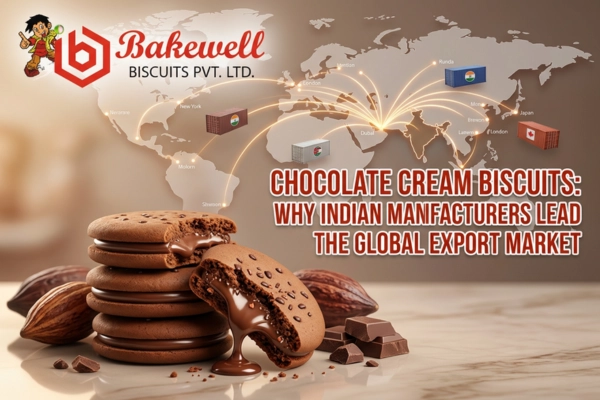
Picture this. A retailer in Nairobi unpacks a shipment of chocolate cream biscuits. A distributor in Dubai places their third reorder this month. A supermarket chain in Colombo has quietly made an Indian-made biscuit one of its top-selling products.
This is not a coincidence. It is the result of something India has been quietly building for decades – world-class biscuit manufacturing that is now meeting the world on its own terms.
If you are a buyer, distributor, importer, or retailer looking to source chocolate cream biscuits in India, this guide is written for you. We will walk you through exactly why demand is rising, what makes Indian manufacturers stand apart, and how to choose the right cream biscuit exporter in India for your business.
Let’s start with what is really happening in the market right now.
The Global Appetite for Chocolate Cream Biscuits Is Growing – And India Is Ready
There is something universally comforting about a chocolate cream biscuit. The satisfying crunch of the outer shell. The smooth, sweet filling in the middle. The way it pairs perfectly with a cup of tea or a glass of milk. It is not just a snack. For millions of people, it is a small daily pleasure.
And that pleasure is becoming global.
The worldwide biscuit market has been growing steadily year on year. Within it, cream biscuits – and especially chocolate cream biscuits – are one of the fastest-moving categories. Markets across Africa, the Middle East, Central Asia, and Southeast Asia are seeing strong, consistent demand growth for packaged biscuits.
Why is this happening? A few powerful trends are driving it:
- Rising urbanisation: As more people move to cities, their eating habits change. Packaged, ready-to-eat snacks become a regular part of daily life.
- Growing middle class: In many developing economies, rising incomes mean people can afford to spend a little more on enjoyable, affordable treats.
- Younger populations: Countries with young demographics have consumers who have grown up with packaged snacks and actively seek them out.
- Limited local manufacturing: Many of these high-growth markets do not have the industrial capacity to produce biscuits at scale. They rely on imports – and that is the opportunity India has stepped into.
Why Buyers Around the World Are Choosing India Over Everyone Else
India is not the only country that makes biscuits. So why is it becoming the preferred choice for so many international buyers? The answer comes down to four things that India does better than most.
1. Manufacturing Scale That Actually Delivers
India has hundreds of biscuit factories spread across states like Gujarat, Maharashtra, Uttar Pradesh, and Karnataka. Many of them run fully automated production lines that can produce thousands of tonnes of biscuits every single month.
For a buyer placing a large or recurring order, this is critically important. You need a supplier who can fulfill your order completely, on time, every time. Indian manufacturers have built that kind of capacity, and they have been doing it reliably for decades.
2. Price Competitiveness Without Cutting Corners
Here is something that surprises many first-time buyers: Indian chocolate cream biscuits are among the most competitively priced in the world, and the quality is excellent.
How is this possible? India benefits from lower labour costs than Western or East Asian manufacturing hubs. Raw materials like wheat, sugar, and vegetable oils are largely locally sourced. And decades of experience in large-scale food manufacturing have made Indian factories extremely efficient.
The result is a product that fits beautifully into the pricing needs of markets where affordability is key, without asking buyers to sacrifice taste or quality.
3. An Enormous Range of Products Under One Roof
Walk into a well-equipped Indian biscuit factory and you will often find they can produce far more than just one or two product types. Chocolate cream biscuits, vanilla cream biscuits, wafers, cookies, sandwich biscuits, toffees, candies – often all from the same manufacturer.
For buyers who want to consolidate their supply chain, this is a significant advantage. Instead of managing multiple suppliers across different countries, you can work with a single, trusted partner in India who handles your full product range.
4. Deep Experience Serving Global Markets
India has been exporting food products for a very long time. The best Indian manufacturers understand what different countries need – not just in terms of the product itself, but in terms of packaging formats, labelling requirements, shelf life expectations, and customs documentation.
When you work with an experienced cream biscuit exporter in India, you are not just buying a product. You are buying expertise.
Certifications, Quality Standards, and Why They Matter More Than You Think
Let’s be honest about something. When you are importing food products from another country, trust is everything. You are putting your brand, your customers, and in some cases your legal compliance on the line every time you place an order.
This is why certifications are not just a nice-to-have. They are the foundation of a credible export partnership. Let’s walk through what to look for and why each one matters.
FSSAI – India’s National Food Safety Standard
Every food product manufactured and sold in India must comply with FSSAI (Food Safety and Standards Authority of India) regulations. For buyers, this is your first baseline assurance. It tells you the product has been made under a legally enforced food safety framework.
Think of it as the minimum standard. Every reputable manufacturer will have this. If they don’t, walk away immediately.
ISO Certification – Global Quality Systems
ISO 22000 (food safety management) and ISO 9001 (quality management) are internationally recognised frameworks that tell buyers the manufacturer has structured, documented processes for quality and safety control.
An ISO-certified factory does not just make good products by accident. It has built systems that make good products consistently, every batch, every time.
HACCP – Hazard Analysis and Critical Control Points
HACCP is a systematic approach to identifying, evaluating, and controlling food safety risks at every step of the production process. If something could go wrong – contamination, temperature exposure, ingredient mislabelling – a HACCP system is what catches it before the product leaves the factory.
For international buyers, especially those supplying retail chains that conduct their own supplier audits, HACCP certification is often a requirement, not an option.
Halal Certification – Opening the Door to a Billion-Plus Consumers
Here is one that many buyers in Western markets underestimate. For the Middle East, large parts of Africa, Malaysia, Indonesia, and significant Muslim communities in Europe, Halal certification is not optional. It is the price of entry.
A Halal-certified cream biscuit exporter in India has confirmed that their ingredients, production processes, and cleaning procedures comply with Islamic dietary law. This single certification can open your product to markets with hundreds of millions of potential customers.
Star Export House Status – A Mark of Seriousness
This is a recognition given by the Indian government to exporters who have demonstrated consistent, high-volume export performance. A Star Export House is not a newcomer. It is a manufacturer with a proven track record in international trade.
When you find a manufacturer who holds Star Export House status alongside FSSAI, ISO, HACCP, and Halal certifications, you have found a serious, established partner.
What Smart Buyers Look for When Choosing a Cream Biscuit Exporter in India
Knowing that India is a great source is one thing. Knowing how to navigate the market and choose the right partner is another. Here is a practical, honest guide based on what experienced importers have learned – sometimes the hard way.
Start With Samples, Not Spreadsheets
The most common mistake first-time buyers make is spending too much time on price negotiations before they have even tasted the product. Do not do this. Always request samples first.
When you receive samples, test them properly. Taste them. Check the texture of the biscuit shell. Assess the chocolate cream filling – is it smooth, consistent, and genuinely chocolatey? Leave the pack open for a few days and see how the biscuit holds up. Put a pack in a warm room and see if the filling separates. These simple tests will tell you more than any specification sheet.
Understand What Export-Grade Really Means
Not every biscuit that is sold domestically in India is suitable for export. Export products face longer transit times, temperature variations during shipping, and stricter destination-country standards. Here is what specifically matters:
- Packaging: Multi-layer laminate pouches and nitrogen-flushed packs significantly extend shelf life and protect the cream filling from heat and moisture during transit.
- Cream stability: A good chocolate cream filling should not separate or become oily even if the pack is exposed to moderate heat during shipping. Ask your supplier about how they achieve cream stability in transit.
- Labelling compliance: Different countries have different rules for food labels. A good supplier will work with you to produce export packaging that meets the specific legal requirements of your destination market, including ingredient lists in the required language, nutritional information, and allergen declarations.
- Shelf life documentation: Always confirm the guaranteed minimum shelf life at point of arrival, not just at point of manufacture.
Ask the Right Questions Before You Commit
A confident, experienced manufacturer will welcome your questions. Here is a checklist that serious buyers use:
- What certifications do you hold? Can I see the certificates?
- What is your production capacity per month for chocolate cream biscuits?
- What is your minimum order quantity (MOQ) for export?
- What is the shelf life, and what packaging do you use for long-distance export?
- Can you handle custom labelling for my destination market?
- Do you offer OEM or private label services?
- Which countries are you currently exporting to?
- Can you provide references from existing international buyers?
Why Gujarat Is at the Heart of India’s Biscuit Export Industry
If you have done any research on sourcing chocolate cream biscuits in India, you have probably noticed that a disproportionate number of manufacturers are based in Gujarat. This is no coincidence.
Gujarat has a long and proud history of food manufacturing and export. The state is home to world-class industrial infrastructure – including GIDC (Gujarat Industrial Development Corporation) industrial estates – that give manufacturers access to reliable utilities, modern facilities, and easy access to major ports for export.
Gujarat manufacturers also benefit from a culture of entrepreneurship and trading that is deeply embedded in the state. They are not new to export. Many of them have been building international relationships for twenty or thirty years.
Modasa, a town in Gujarat, has in particular become known for quality food manufacturing. Companies like Bakewell Biscuits Pvt. Ltd., operating under the FUN2 brand, are based here – producing chocolate cream biscuits, wafers, toffees, candies, and more for buyers across the Middle East, Africa, Southeast Asia, and beyond. Holding FSSAI, ISO, HACCP, Halal, and Star Export House certifications, Bakewell is a strong example of what a credible Gujarat-based cream biscuit exporter in India looks like.
Where Are Indian Chocolate Cream Biscuits Being Exported?
Let’s make this concrete. Where exactly are buyers sourcing Indian chocolate cream biscuits, and why are those markets so well-served by Indian manufacturers?
The Middle East
UAE, Saudi Arabia, Qatar, Oman, and Bahrain are among the most active importers of Indian biscuits. The large South Asian diaspora in these countries actively seeks familiar tastes from home. At the same time, local consumers have embraced affordable, quality Indian snacks. Halal certification is essential in this market, and Indian manufacturers who hold it have a clear pathway to retail shelves here.
East and West Africa
Kenya, Tanzania, Ethiopia, Uganda, Nigeria, Ghana – African markets are experiencing some of the fastest growth in packaged food consumption in the world. Indian-made chocolate cream biscuits hit the sweet spot of affordability, quality, and availability that these markets need. Several Indian exporters have built strong, long-term relationships with African distributors who reorder consistently.
South and Southeast Asia
Sri Lanka, Bangladesh, Nepal, Myanmar, and parts of Southeast Asia have strong cultural affinities with Indian food and have been importing Indian biscuits for years. Proximity reduces shipping costs and allows for faster turnaround on orders, making India a natural choice for buyers in this region.
Central Asia and Emerging Markets
Kazakhstan, Uzbekistan, and several Eastern European and Central Asian nations have shown growing appetite for affordable imported snacks. Indian manufacturers who have positioned themselves competitively on price have found eager buyers in markets that many Western manufacturers have not bothered to serve well.
The Future Looks Sweet: Trends Driving India’s Biscuit Export Growth
This is not a moment in time. It is a long-term shift. Several powerful trends are working together to make Indian chocolate cream biscuit exports stronger every year.
India’s Improving Trade Agreements
India has been actively negotiating and finalising trade agreements with key export markets across Africa, the Middle East, and Southeast Asia. Reduced import duties mean Indian products become even more price-competitive in these markets, widening the cost advantage that Indian manufacturers already hold.
Better Logistics and Port Infrastructure
Getting biscuits from a factory in Gujarat to a retailer in Nairobi or a distributor in Dubai has become faster and more reliable than ever. India’s port infrastructure has improved dramatically, and freight networks specifically designed for FMCG and food products are now well-established.
For buyers, this translates to shorter lead times, fewer shipment delays, and greater confidence in supply chain reliability.
Product Innovation Is Moving Fast
Indian manufacturers are not standing still. There is genuine innovation happening in the category – new chocolate cream flavours, biscuits with higher cocoa content targeting premium markets, healthier ingredient formulations for health-conscious consumers, resealable packaging that extends product life after opening, and premium gift-style formats.
This innovation is opening higher-value market segments that Indian manufacturers have historically not competed in. The range of what is possible when sourcing chocolate cream biscuits in India has genuinely expanded.
Digital Access Is Making Sourcing Easier
Five years ago, finding a reliable cream biscuit exporter in India required trade missions, personal introductions, or expensive trade directories. Today, digital channels, virtual trade shows, and direct manufacturer websites have made the sourcing process far more accessible.
Buyers who know what to look for – certifications, export experience, product range, and communication quality – can now do meaningful supplier research from their desk before making a single call.
We have covered a lot of ground in this article. Let’s bring it together simply.
The global demand for chocolate cream biscuits is real and growing. Indian manufacturers are uniquely positioned to serve that demand – with scale, price competitiveness, quality, a wide product range, and certifications that international buyers need.
Gujarat, in particular, has built a remarkable concentration of credible, experienced, export-focused biscuit manufacturers who understand exactly what international buyers need and have been delivering it for years.
Whether you are a distributor building out your snack portfolio, a retailer considering a private label range, or an importer looking to diversify your supply chain, working with a trusted cream biscuit exporter in India gives you access to products that are competitive on every dimension that matters.
Quality. Price. Compliance. Availability. Reliability. India delivers on all of them.
The manufacturers who have built India’s biscuit export story have not done it by accident. They have done it by taking their craft seriously, investing in the right systems, showing up at global trade events, and building relationships with buyers who trust them.
That is the kind of partner your business deserves.